
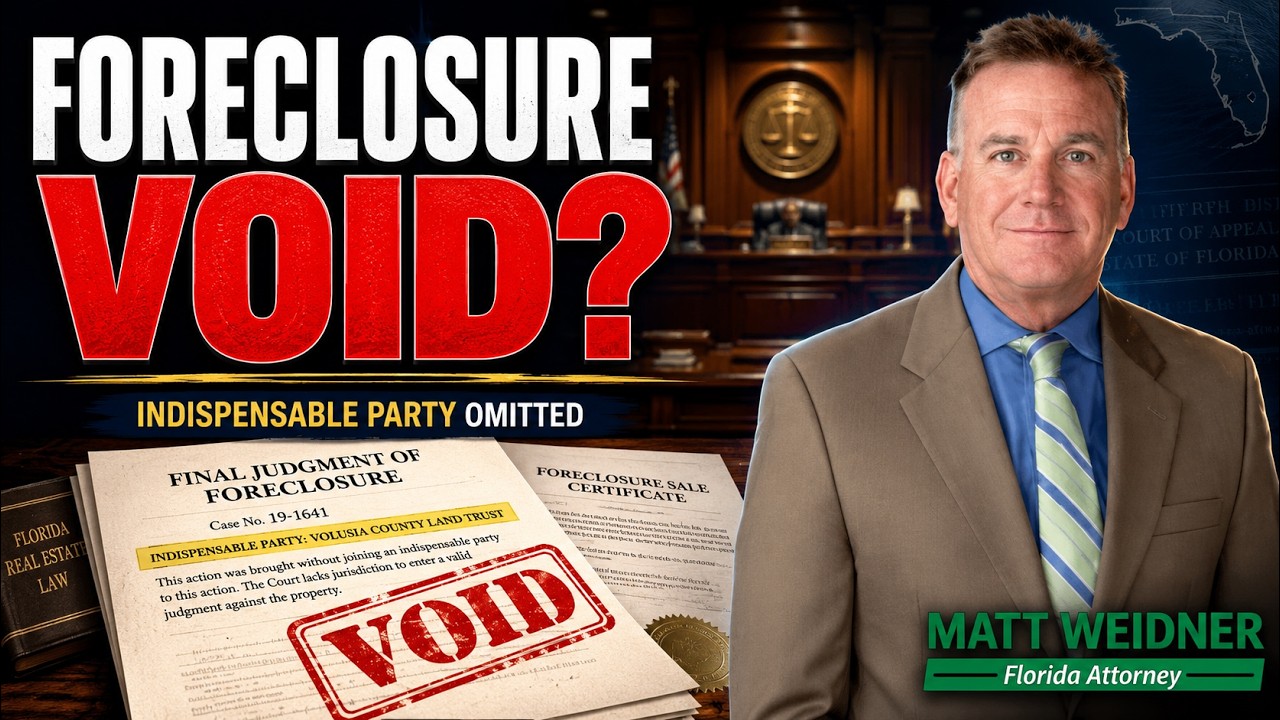
In short: The omitted owner keeps its interest, but it may not get the property free and clear. The buyer at the sale can step into the foreclosing lender’s shoes and re-foreclose, leaving the omitted owner a right to redeem by paying the debt. In Volusia County Land Trust v. The Bank of New York Mellon, the Fifth District affirmed a judgment of re-foreclosure against a land trust that was left out of the bank’s foreclosure, in a short per curiam opinion filed July 31, 2020.
The Facts
The Fifth District’s opinion is a one-line citation affirmance, so the facts below come from the oral argument, not from findings by the appellate court.
A Volusia County land trust held record title to a home. According to the argument, it took title through an association lien sale, subject to an existing first mortgage. The Bank of New York Mellon later foreclosed that first mortgage but did not name the land trust as a defendant. The property was sold at the foreclosure sale and ended up with Ingrid Nishi.
The land trust sued the bank and Ms. Nishi for damages. Ms. Nishi counterclaimed to re-foreclose the mortgage against the land trust as the equitable assignee of the mortgagee. The trial court entered a judgment of re-foreclosure, and the land trust appealed.
- The land trust argued that the record title holder was an indispensable party, so the bank’s judgment and sale were void, the buyer received nothing, and only the bank, or someone holding an actual assignment from it, could foreclose against the land trust in a new action.
- Ms. Nishi argued that when a foreclosure is imperfect for any reason, the sale buyer is subrogated to the mortgagee’s rights and may re-foreclose the omitted interest, leaving the omitted party a right to redeem. She relied on a June 2020 Fourth District decision on nearly identical facts.
- The panel asked whether the old Florida Supreme Court cases allowing re-foreclosure apply only to omitted junior lienholders, not to the owner, and noted that the bank, not the land trust, was responsible for naming the right parties.
The Decision
The Fifth District affirmed on July 31, 2020, in a per curiam opinion that cites only Lucky Nation, LLC v. Al-Maghazchi, No. 4D19-2097 (Fla. 4th DCA June 17, 2020). The mandate issued on August 24, 2020.
In Lucky Nation, the owners had acquired their interest through a homeowners’ association lien foreclosure and were not named in the later first mortgage foreclosure. The Fourth District held that the sale buyer could re-foreclose as equitable subrogee of the original first mortgage holder and that the omitted owners were properly given a right to redeem. It reversed only the redemption amount, which wrongly included interest, taxes and expenses incurred after the original foreclosure complaint was filed.
By citing Lucky Nation alone, the Fifth District signaled that the same reasoning supported the judgment here. A citation affirmance does not explain how the court dealt with the void-judgment argument.
The Law
A foreclosure binds only the parties to it. Owners and lienholders who are not named keep their interests. Rule 1.210(a) governs who must be joined as parties, and rule 1.540(b)(4) allows relief from a void judgment.
The right of redemption is set by section 45.0315. A mortgagor or the holder of a subordinate interest may redeem by paying the amount required by the judgment before the certificate of sale is filed or a later time set in the judgment. A judgment of re-foreclosure gives the omitted party that same choice: pay the debt or lose the interest.
A recorded lis pendens under section 48.23 binds people who acquire interests after it is filed. As a judge noted at argument, it does nothing to someone who already held title of record before the lis pendens was recorded, which is why naming every record owner matters.
Lessons
- If you own property subject to a mortgage and the lender forecloses without naming you, the sale buyer may be able to re-foreclose against you. Your practical remedy may be to redeem by paying the debt.
- Buying at an association lien sale does not remove the first mortgage. You take subject to it.
- Lenders and their title searchers must name every record owner. Leaving one out creates years of extra litigation.
- Sale buyers who discover an omitted owner have tools, including re-foreclosure as equitable subrogee, but should confirm the redemption amount is calculated correctly.
Source: Volusia County Land Trust #703501-05-2730 v. The Bank of New York Mellon, No. 5D19-1641 (Fla. 5th DCA July 31, 2020) (per curiam affirmed, citing Lucky Nation, LLC v. Al-Maghazchi, No. 4D19-2097 (Fla. 4th DCA June 17, 2020)); ACIS docket.
Watch the Oral Argument
This is the recording of the actual oral argument, posted on the channel. What lawyers and judges say at argument is not the ruling; the decision is summarized above.
🔏 Title Holder Left Out of the Foreclosure — Void Judgment or Just a Right of Redemption?
Read the Law on FloridaRules.net
The statutes and court rules discussed in this article, free to read on FloridaRules.net:
Go Deeper
- Duh! (Foreclosure is Void if Property Owner Not Named)
- Refinance Missed the Second Mortgage, Subrogation Denied (Sherman v. Deutsche Bank)
- The Florida Foreclosure Sale: Timing, Redemption, Surplus Funds, and When You Have to Move
Frequently Asked Questions
What happens if the owner was not named in a Florida foreclosure?
The owner’s interest is not foreclosed. But under Volusia County Land Trust and Lucky Nation, the buyer at the sale can re-foreclose as equitable subrogee of the lender, and the omitted owner gets a right to redeem by paying the debt or loses its interest.
Is a foreclosure judgment void if a title holder was left out?
It does not bind the omitted owner. Whether the whole judgment and sale are void was the land trust’s argument, and the Fifth District affirmed the re-foreclosure without accepting it. Courts have treated the problem as one the buyer can fix by re-foreclosing.
Can the buyer at a foreclosure sale re-foreclose against someone who was left out?
Yes, under these decisions. The buyer is treated as stepping into the shoes of the foreclosing lender and can bring a re-foreclosure against the omitted interest without a written assignment from the bank.
How much does an omitted owner have to pay to redeem?
The redemption amount is tied to the mortgage debt under section 45.0315. In Lucky Nation, the Fourth District reversed a redemption figure that improperly added interest, taxes and expenses incurred after the original foreclosure complaint was filed.
Talk to a Florida real estate litigation lawyer
Weidner Law, P.A. handles Florida real estate disputes, title problems and appeals from St. Petersburg. If you need a real estate litigation lawyer, call (727) 954-8752 or email weidner@mattweidnerlaw.com.
Read the law yourself, free: every Florida statute and court rule is on floridarules.net.
This article is general information about Florida law, not legal advice about your situation. Reading it, watching the videos, or contacting the firm does not create an attorney-client relationship. Every case turns on its own facts, and past results do not guarantee a similar outcome. The hiring of a lawyer is an important decision that should not be based solely upon advertisements.
