
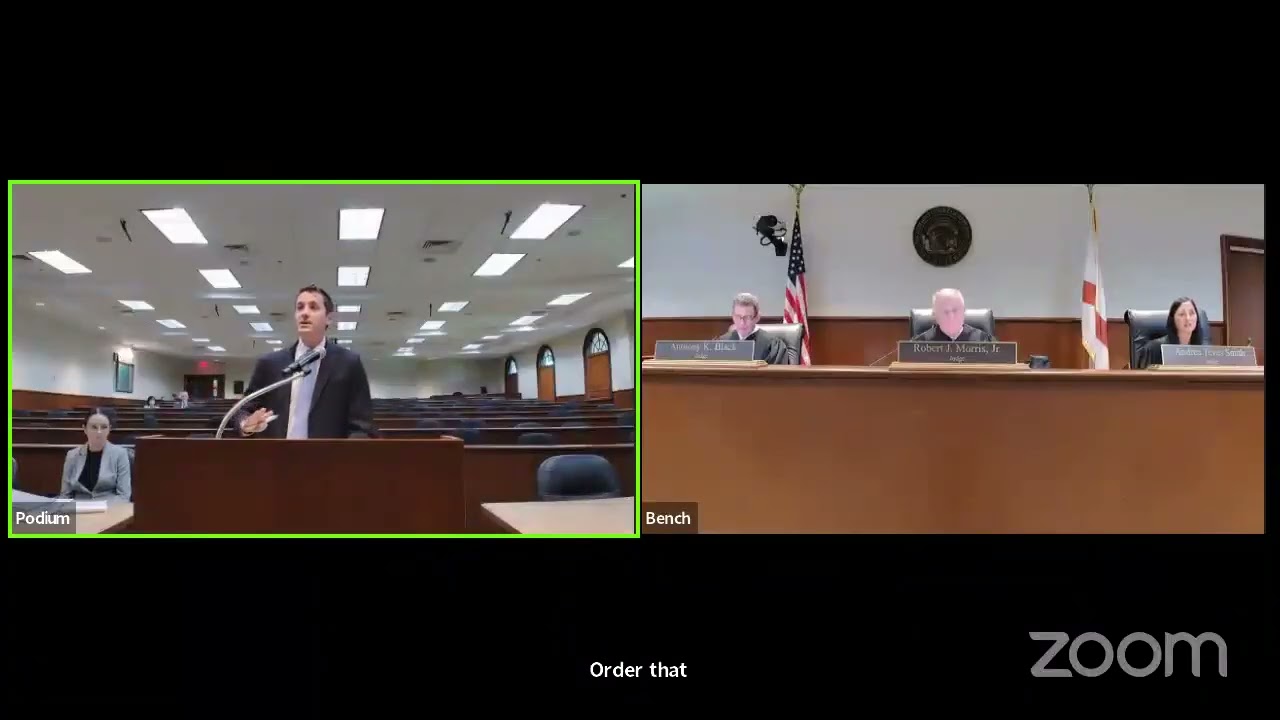
In short: In Womack v. Womack, two adult children challenged a January 2022 deed their nearly 90-year-old mother signed, claiming she lacked capacity. A Pinellas County judge ordered her to undergo a four-hour neuropsychological examination by the challengers’ expert, with her lawyer watching from another room. She asked the Second District to stop the exam by certiorari. On December 18, 2024, the court denied the petition in a one-word decision without explanation.
The Facts
Mary Lou Womack signed documents in January 2022, including a deed to her house. According to her lawyer at argument, she wanted the house to go to her daughter Susan and Susan’s wife, Karen Cecil, who were caring for her. Two of her other children, Lynne and Michael Womack, challenged the documents in Pinellas County circuit court, claiming she lacked capacity and was a vulnerable adult subject to undue influence.
After Mrs. Womack became a party, the challengers asked the court to compel a neuropsychological examination by their expert. The trial court ordered an examination of up to four hours, with breaks, and directed that her counsel not be in the room, though counsel could observe from a separate room. Mrs. Womack petitioned the Second District for a writ of certiorari, and the case was argued on September 24, 2024. The points below are what the lawyers argued, not findings by the court.
- Her lawyer argued the only question is her capacity in January 2022, not today. The challengers’ expert had already given an opinion based on records from that time, and no one explained how an exam nearly three years later would show her condition when she signed.
- He argued the order was too open-ended because it did not say which tests would be given, that the burden is on the party seeking the exam to show good cause, and that excluding counsel from the room requires a case-specific justification and proof no other qualified examiner would allow counsel present.
- He suggested the exam could be used to keep her from testifying at trial about why she signed the deed.
- The challengers argued her mental condition is central to the case, that the defense expert had already examined her, that disclosing the specific tests in advance risked coaching, and that letting counsel watch from another room is not exclusion.
- The panel focused on the certiorari standard: whether the order departed from the essential requirements of law and caused harm that cannot be fixed on appeal. Judges also asked how the order limited the scope of testing.
The Decision
The Second District denied the petition on December 18, 2024. The published decision, Womack v. Womack, 399 So. 3d 1254, says only “Denied.” The mandate issued January 24, 2025.
A one-word denial does not explain the court’s reasons. It could rest on the lack of irreparable harm, on the merits of the order, or on both. It leaves the trial court’s examination order in place, but it is not a ruling that every compelled examination in a capacity case is proper.
The Law
Florida Rule of Civil Procedure 1.360 allows a court to order a party’s physical or mental examination when that condition is in controversy. The party asking must show good cause, and the request must describe the time, place, manner, conditions and scope of the examination and identify the examiner. Florida courts have rejected open-ended orders that do not say what testing will be done.
Capacity to sign a deed is measured when the deed is signed. That is why the timing of an examination matters: an exam today shows current condition, and the expert must explain how it bears on the earlier date.
Certiorari is a narrow remedy for non-final orders. The petitioner must show the order departs from the essential requirements of law and causes material harm that cannot be corrected on appeal from the final judgment. Petitions are governed by Florida Rule of Appellate Procedure 9.100.
Disputes like this often overlap with guardianship. Section 744.331 sets out a separate process, with a court-appointed examining committee, for deciding whether a person is incapacitated today.
Lessons
- When a deed or will is challenged for lack of capacity, expect a fight over the signer’s medical records, and possibly over a compelled examination.
- If you oppose a compelled exam, focus the trial court on good cause and scope: which tests, how long, by whom, and how today’s results relate to the date of signing.
- Ask the trial court for findings. A one-word appellate denial leaves little room for review, so the record built below matters most.
- Families can reduce later fights by having a capacity evaluation and an independent lawyer’s notes made when an elderly parent signs a deed or will.
Source: Womack v. Womack, 399 So. 3d 1254 (Fla. 2d DCA 2024), No. 2D2024-1268, petition denied December 18, 2024; ACIS docket.
Watch the Oral Argument
This is the recording of the actual oral argument, posted on the channel. What lawyers and judges say at argument is not the ruling; the decision is summarized above.
🧠 Court Orders Elderly Woman Into Forced Mental Exam — Irreparable Harm? | Wack v. Appellees
Go Deeper
- Testamentary Capacity in Florida: When Dementia Makes a Will, Deed, or POA Invalid
- How to Contest a Guardianship in Florida: The Incapacity Hearing, Your Rights, and Restoration
- Elder Abuse Warning Signs in Florida: Why the Exploiter Is Usually Family
Frequently Asked Questions
Can a Florida court force someone to take a mental exam?
Yes, under Rule 1.360, if the person’s mental condition is in controversy and the requesting party shows good cause. The order should spell out the scope, conditions and examiner. In Womack v. Womack, the trial court ordered a four-hour neuropsychological exam of a nearly 90-year-old woman, and the Second District denied review.
How do you prove someone lacked capacity to sign a deed?
Capacity is judged at the time of signing, so the best evidence is usually from that time: medical records, the lawyer’s notes, witnesses and any contemporaneous evaluation. In Womack, the mother’s lawyer argued that both sides’ experts had relied on those records, not on a current exam.
Can my lawyer be in the room during a compelled psychological exam in Florida?
Generally the party trying to exclude counsel must justify it. In Womack, the trial court let counsel observe from a separate room. The Second District denied review without saying whether that arrangement was proper.
What is certiorari review of a discovery order?
It is a narrow way to challenge a non-final order before trial. The petitioner must show a departure from the essential requirements of law and harm that cannot be fixed on appeal. Mrs. Womack argued a compelled exam cannot be undone once it happens, but the court denied her petition without explanation.
Talk to a Florida probate litigation lawyer
Weidner Law, P.A. handles Florida probate disputes and probate appeals from St. Petersburg. If you need a probate litigation lawyer, call (727) 954-8752 or email weidner@mattweidnerlaw.com.
Read the law yourself, free: the full Florida Probate Code and Probate Rules and the Florida Trust Code are on floridarules.net.
This article is general information about Florida law, not legal advice about your situation. Reading it, watching the videos, or contacting the firm does not create an attorney-client relationship. Every case turns on its own facts, and past results do not guarantee a similar outcome. The hiring of a lawyer is an important decision that should not be based solely upon advertisements.
