
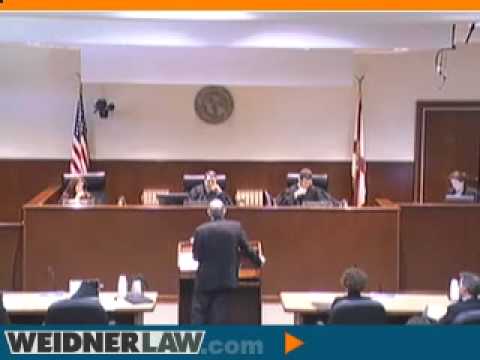
In short: Under current Florida case law, usually not: a former owner of commercial property is generally not liable to people hurt on the land after the sale, because caveat emptor still governs commercial sales and the duty to keep premises safe follows possession and control. In Steele v. Georgia-Pacific and the companion Martinez estate appeal, the estates of two workers killed when a 300,000-gallon water tank failed argued that Georgia-Pacific hid the tank’s corrosion when it sold the property. The trial court dismissed their claims against Georgia-Pacific, and the Second District affirmed without a written opinion on November 5, 2014.
The Facts
This summary comes from the oral argument, because the court issued no opinion. The appeal was from an order dismissing the complaints, so the facts below are what the plaintiffs alleged, not findings.
Georgia-Pacific owned industrial property in Hillsborough County with a 300,000-gallon water tank that was part of the fire suppression system. According to the complaints, Georgia-Pacific knew the tank was severely corroded, and Simplex Grinnell, the company that inspected the system, had told it so. Georgia-Pacific sold the property as is to Consulting R.E., LLC, a company owned by Leo Bruso. The plaintiffs alleged that Georgia-Pacific actively concealed the corrosion during the sale, told Simplex the tank had passed inspection, and that the buyer was not likely to discover the problem.
About six months after the sale, workers employed by United Fire came to repair the fire suppression pumps. The tank failed and two of them, Jason Steele and Jon Andre Martinez, were killed. Their estates sued Georgia-Pacific, the buyer and others. The trial court dismissed the claims against Georgia-Pacific, and the estates appealed (Nos. 2D13-3453 and 2D13-3490, consolidated for oral argument). At argument:
- The estates argued Georgia-Pacific conceded in its brief that caveat emptor does not protect a seller who actively conceals a dangerous defect, and that the as-is contract between seller and buyer cannot bind third parties who never signed it.
- They asked the court to apply Restatement (Second) of Torts section 353, which makes a seller who conceals a dangerous condition it knows the buyer is unlikely to find liable to people later hurt on the land. They argued a 1988 First District decision had already applied it and said 29 states follow it. In the alternative, they asked the court to certify the question to the Florida Supreme Court.
- Georgia-Pacific argued that under Florida premises liability law the duty runs only from whoever possesses or controls the land when the injury happens, which here was the buyer. It argued caveat emptor still governs commercial sales, that any concealment claim belonged to the buyer, and that the buyer had inspected the property, assumed the risk of latent defects, and disclaimed reliance on any representations in the contract.
- The panel pointed to Haskell Co. v. Lane Co., 612 So. 2d 669 (Fla. 1st DCA 1993), where the First District applied caveat emptor to bar injury claims against a former owner of commercial property and certified the question to the Florida Supreme Court. Judges also asked whether workers hired to repair the very system that failed were the kind of remote third parties a disclosure duty would protect.
The Decision
The Second District affirmed both appeals per curiam on November 5, 2014, without a written opinion. The estates filed a joint motion for rehearing, rehearing en banc, or a written opinion. The court denied it in April 2015, and the mandates issued in May 2015.
A per curiam affirmance does not say which argument won. It means the dismissal of the claims against Georgia-Pacific stands. It does not adopt or reject section 353 of the Restatement, and it is not precedent for other cases.
The Law
Caveat emptor, “let the buyer beware,” is still the starting rule for sales of commercial real property in Florida. The buyer is expected to inspect, and the seller generally has no duty to disclose defects. Courts recognize exceptions, including active concealment and half-truths, but those exceptions protect the buyer.
For homes, the Florida Supreme Court took a different path in Johnson v. Davis, 480 So. 2d 625 (Fla. 1985), which requires a seller of residential property to disclose known facts that materially affect its value and are not readily observable. Johnson does not apply to commercial property.
Premises liability usually follows possession and control. Once a seller hands over a commercial property, the new owner is generally the party responsible for its condition. The estates asked the court to recognize section 353 of the Restatement as an exception for a seller who knowingly hides a dangerous defect. Haskell certified that broader question in 1993, and the plaintiffs here asked again for certification; the Second District declined to write or certify.
The case was decided on a motion to dismiss for failure to state a cause of action under rule 1.140, where the court accepts the complaint’s allegations as true. That is why the case turned on whether the law recognizes a duty at all, not on what Georgia-Pacific actually knew.
Lessons
- If you are hurt on commercial property, the claim usually runs against whoever owns or controls it now. Suing a former owner on a concealment theory is an uphill fight in Florida.
- Buyers of commercial property should inspect hard, especially tanks, structures and life-safety systems. As-is and non-reliance clauses can shift the risk of hidden defects to the buyer.
- Sellers who know of a dangerous condition still face risk from their buyer on a concealment theory, and from disclosure duties in residential sales. Disclosing in writing is the safer course.
- A PCA ends the case but sets no rule. Whether Florida will adopt Restatement section 353 for commercial sellers remains an open question for a court willing to write on it.
Source: Steele v. Georgia-Pacific LLC, No. 2D13-3453 — Fla. 2d DCA docket (per curiam affirmed November 5, 2014); companion case Chubey v. Georgia-Pacific, LLC, No. 2D13-3490 (Estate of Jon Andre Martinez).
Watch the Oral Argument
This is the recording of the actual oral argument, posted on the channel. What lawyers and judges say at argument is not the ruling; the decision is summarized above.
🏗️ Sold the Property and Hid the Corroded Tank: Does a Seller's Concealment State a Claim?
Read the Law on FloridaRules.net
The statutes and court rules discussed in this article, free to read on FloridaRules.net:
Go Deeper
- Vacant Lot Buyers Lose Nondisclosure Case Over Hidden Muck (Eiman v. Sullivan)
- Neighbor Fell Into a Hole From the Construction Site Next Door (Schramm v. Adams Homes)
- Buyer Found Out Years Later Its Raw Land Was Condo Property: Too Late (West Brook Isles)
Frequently Asked Questions
Can I sue the former owner if I was hurt on commercial property after it was sold?
Usually not in Florida. The duty to keep premises safe generally belongs to whoever possesses and controls the property when the injury happens. In Steele v. Georgia-Pacific, the dismissal of the estates’ claims against the former owner was affirmed without an opinion.
Does caveat emptor still apply to commercial real estate in Florida?
Yes. Florida courts still apply caveat emptor to commercial sales, so the buyer is expected to inspect. Exceptions exist for active concealment and partial disclosures, but they generally protect the buyer, not later third parties.
Does a Florida seller have to disclose defects when selling a house?
For residential property, yes. Under Johnson v. Davis, a seller who knows of facts materially affecting the value of a home that are not readily observable must disclose them. That duty does not extend to commercial property.
What does buying property "as is" mean in Florida?
It means the buyer takes the property in its current condition and accepts the risk of defects, usually after a chance to inspect. In the Georgia-Pacific sale, the buyer also disclaimed reliance on the seller’s statements and assumed the risk of latent defects. Whether as-is language bars a buyer’s own fraud claim depends on the contract and on whether the defect could have been found with ordinary diligence.
Talk to a Florida real estate litigation lawyer
Weidner Law, P.A. handles Florida real estate disputes, title problems and appeals from St. Petersburg. If you need a real estate litigation lawyer, call (727) 954-8752 or email weidner@mattweidnerlaw.com.
Read the law yourself, free: every Florida statute and court rule is on floridarules.net.
This article is general information about Florida law, not legal advice about your situation. Reading it, watching the videos, or contacting the firm does not create an attorney-client relationship. Every case turns on its own facts, and past results do not guarantee a similar outcome. The hiring of a lawyer is an important decision that should not be based solely upon advertisements.
