
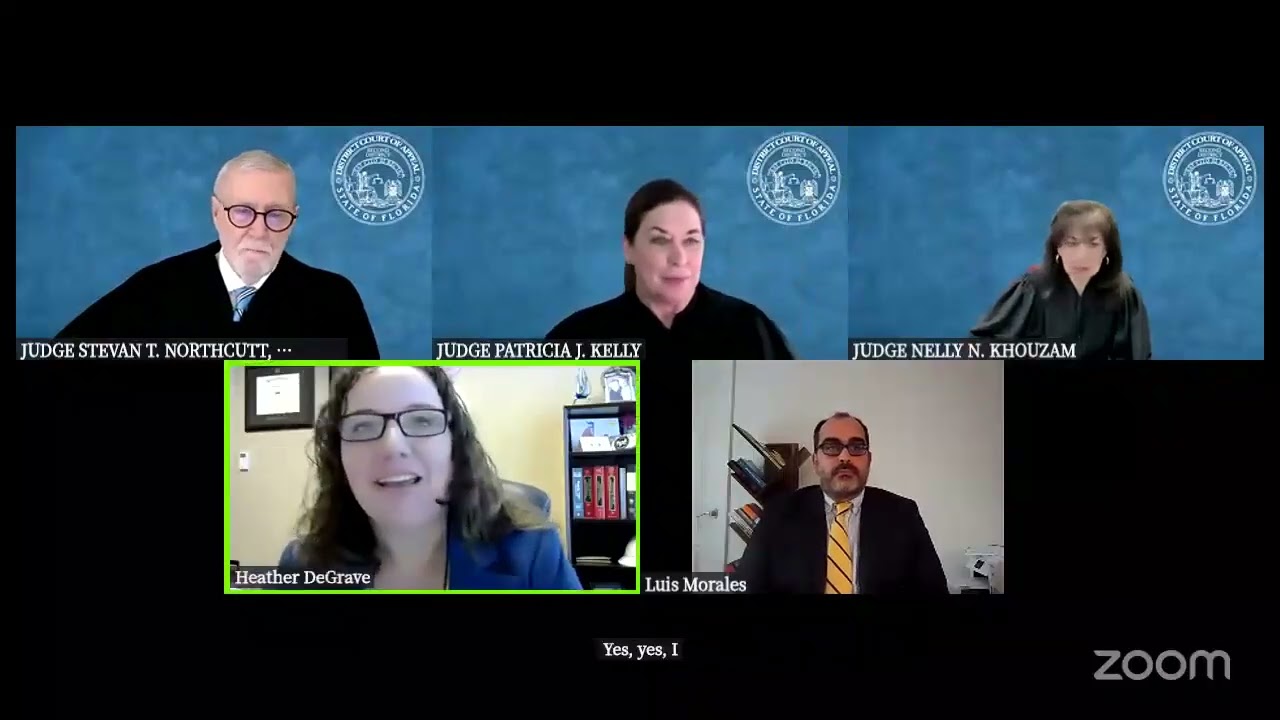
In short: Sometimes: Florida recognizes a common-law way of necessity and a statutory way of necessity under section 704.01, but the owner has to prove there is no practicable access. In Dominguez v. DGP&S Construction, a Hillsborough owner lost his landlocked-parcel and lease claims at a nonjury trial that had no transcript. The Second District affirmed on December 27, 2024, without a written opinion.
The Facts
Mauricio Dominguez sued DGP&S Construction, Inc. and Feliciano Morales in Hillsborough County. After a two-day nonjury trial, the trial court entered judgment against him on his claims, and he appealed (No. 2D2024-0539), filing his initial brief on his own. The defendants cross-appealed on their fraud counterclaims. There is no written opinion, so what follows is what the lawyers argued on December 11, 2024, not findings by the appellate court.
- Dominguez’s lawyer, Luis Morales, argued his client’s small parcel became landlocked after the defendants petitioned to vacate North 60th Street and fenced the property, and that wetlands blocked access to the north. He argued for a common-law way of necessity and, alternatively, a statutory way of necessity because the land had been used as a shrimp farm, an agricultural use.
- He argued the trial court wrongly found no valid rental agreement for the small parcel, pointing to payments made under it.
- The defendants’ lawyer, Heather DeGrave, argued there was no trial transcript, so the trial court’s factual findings had to be presumed correct, and that several issues were not raised in the initial brief.
- She argued the trial court credited testimony that a handwritten term raising the rent from $500 to $1,000 a week was added after signing, and that Dominguez had lost the larger parcel in a foreclosure.
- On the cross-appeal she asked for a remand so the trial court could decide whether Dominguez knew or should have known his statements were false, the knowledge element of fraudulent misrepresentation. His lawyer answered that fraud requires actual knowledge.
The Decision
The Second District affirmed on December 27, 2024. ACIS shows the disposition as “Affirmed” with no opinion text. The court denied Dominguez’s motion for a written opinion and rehearing on February 26, 2025, and the mandate issued March 13, 2025.
The same day it affirmed, the court provisionally granted the defendants appellate attorney’s fees under their proposals for settlement, in an amount to be set by the trial court if the trial court finds they are entitled to fees.
A per curiam affirmance decides only this case. It leaves the final judgment in place, including the parts each side challenged, and does not say which arguments carried the day.
The Law
Florida has two kinds of way of necessity, both in section 704.01. The common-law version, in section 704.01(1), is implied when land is conveyed with no access except over the seller’s land, and it requires unity of title from a common source. The statutory version, in subsection (2), applies to land used or desired for a dwelling, agriculture, timber or stockraising that is shut off so that no practicable route of ingress or egress is available. Under section 704.04, the owner of the land crossed by a statutory way of necessity is entitled to compensation, which a circuit court sets if the parties cannot agree.
On appeal, the person challenging the judgment must provide a record showing the error. Without a transcript of the trial, an appellate court generally presumes the trial court’s factual findings are supported by the evidence.
Proposals for settlement under section 768.79 and rule 1.442 can shift attorney’s fees to a party whose offer was rejected and who then did better at trial. Here they also supported a provisional award of appellate fees.
Lessons
- Hire a court reporter for trial. Without a transcript, it is very hard to win an appeal that challenges the facts.
- To claim a way of necessity, be ready to prove there is no practicable access, not just that access is inconvenient. Maps and surveys help.
- A handwritten change to a lease invites a credibility fight. Have both sides initial changes when they are made.
- Rejecting a proposal for settlement can cost you the other side’s fees, including fees on appeal.
- Raise every issue in the initial brief. Issues first argued in a reply brief are usually not considered.
Watch the Oral Argument
These are two uploads of the same oral argument, held by video conference on December 11, 2024. What lawyers and judges say at argument is not the ruling; the decision is summarized above.
🏗️⚖️ Construction Dispute Ends in Affirmance: Dominguez v. DGP&S Construction | 2D24-0539
🏗️ Dominguez v. DGP&S Construction — Appeal LOST! Fees Awarded | 2D2024-0539
Read the Law on FloridaRules.net
The statutes and court rules discussed in this article, free to read on FloridaRules.net:
Go Deeper
- Easement Disputes in Florida: Utility, Access, and Prescriptive Easements
- No Written Easement, No Parking Access: Condo Loses Driveway Claim (Miami Beach Club v. RDR)
- A Handwritten 50-Year Lease Signed by Only One Owner (Corbin v. McDaniel)
Frequently Asked Questions
What can I do if my property in Florida is landlocked?
You may have a way of necessity under section 704.01, either the common-law version based on how the land was divided or the statutory version for land with no practicable access. In Dominguez, the trial court found the owner did not prove his case, and that was affirmed.
What is the difference between a common-law and a statutory way of necessity in Florida?
The common-law way requires that both parcels once had the same owner and the split cut off access. The statutory way does not require common ownership but applies only to land used for a dwelling, agriculture, timber or stockraising, and the neighbor whose land is crossed is entitled to compensation under section 704.04.
Can I win an appeal without a trial transcript?
Rarely, if you are challenging the facts. The appellate court presumes the trial court’s findings are correct when there is no transcript. An error of law apparent on the face of the judgment is the main exception, which Dominguez’s lawyer argued.
Can I be ordered to pay the other side's appeal fees in Florida?
Yes, if there is a legal basis such as a rejected proposal for settlement under section 768.79. In Dominguez, the court provisionally granted the defendants appellate fees, leaving entitlement and amount to the trial court.
Talk to a Florida real estate litigation lawyer
Weidner Law, P.A. handles Florida real estate disputes, title problems and appeals from St. Petersburg. If you need a real estate litigation lawyer, call (727) 954-8752 or email weidner@mattweidnerlaw.com.
Read the law yourself, free: every Florida statute and court rule is on floridarules.net.
This article is general information about Florida law, not legal advice about your situation. Reading it, watching the videos, or contacting the firm does not create an attorney-client relationship. Every case turns on its own facts, and past results do not guarantee a similar outcome. The hiring of a lawyer is an important decision that should not be based solely upon advertisements.
