
In short: Not if the recorded declaration makes the land a common area and the developer never carved the air rights out before its duty to convey arose. In Quay 1 and 9, LLC v. Block 6 Condominium Association, the master developer of The Quay in downtown Sarasota sold air rights above the Quay Commons road to a sub-developer, and the trial court ruled the developer had no title to sell because the road, air rights included, was a common area it had to convey to the master association once developed. The Second District affirmed without a written opinion on June 4, 2025, and denied rehearing on July 28, 2025.
The Facts
Quay Venture, LLC was the master developer of The Quay, a mixed-use project in downtown Sarasota governed by a recorded master declaration. Section 3.1 of the declaration defined common areas as real property within Quay Sarasota “designed and intended by the master developer for common use,” and section 3.2 required the developer to convey common areas to the master association “as and when developed.” Quay Commons, a road through the project, was shown on the declaration’s Exhibit D.
In September 2021 Quay 1 and 9, LLC was formed and contracted to buy property that included two parcels of air rights above Quay Commons. Block 6 Condominium Association, representing owners in a completed residential block, sued. After a bench trial, the trial court ruled that Quay Commons, including the air rights above it, was a common area, that it had been developed by April 2021, and that the master developer had no title to sell the air rights. Quay 1 and 9, Quay Venture and the Quay Sarasota Master Association appealed (No. 2D2023-2631).
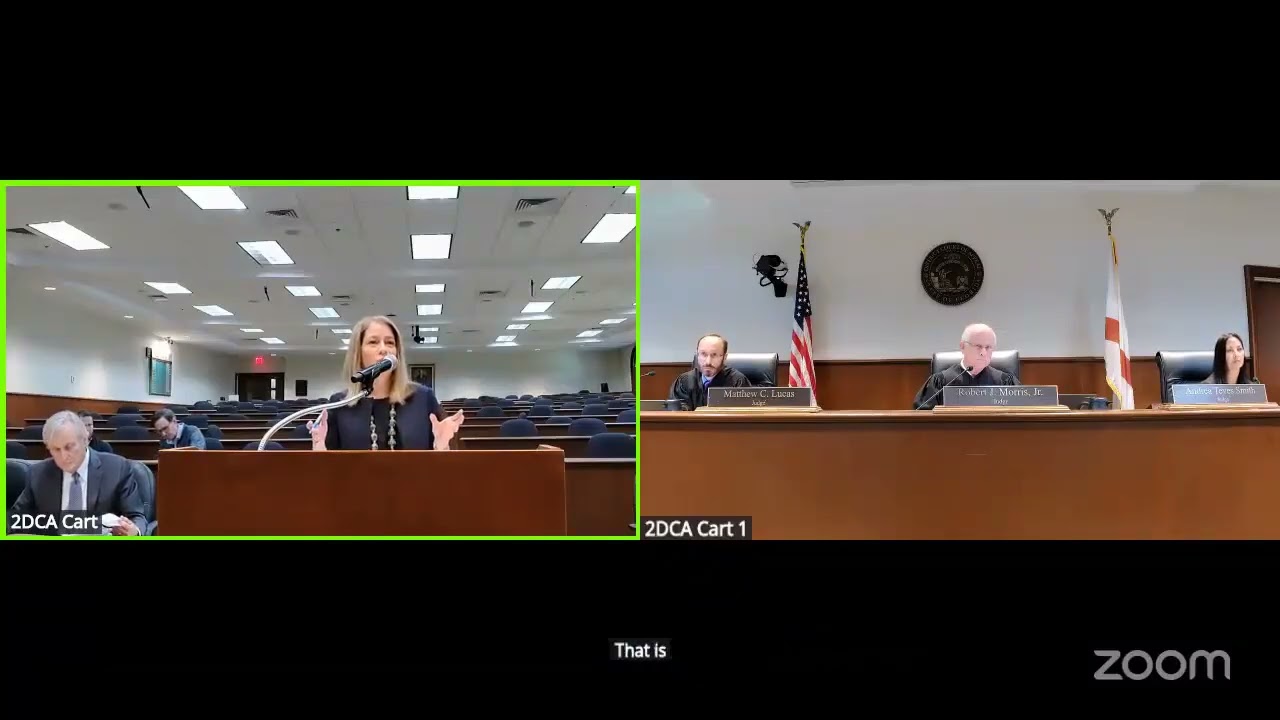
The case was argued on May 20, 2025. Ceci Culpepper Berman argued for the appellants and David A. Wallace for Block 6. The points below are what the lawyers argued, not findings by the appeals court.
- The developers argued the declaration is not ambiguous: a common area is whatever the master developer intends for common use, and the developer could change that, including carving out air rights, as the project evolved. Nothing in the declaration required a recorded document to do so, they said.
- They argued “developed” is different from “completed.” The road was usable and being assessed for maintenance, but it would be torn up for tie-ins and still needed its final lift of asphalt, so the duty to convey had not yet arisen.
- The panel pressed on how the developer’s intent could be shown to the world without a recorded supplemental declaration, noting the declaration said such determinations are binding when evidenced by one, and asked whether a building over the road fit the general development plan’s ten residential blocks.
- Block 6 argued the declaration itself defined Quay Commons as a common area and dedicated it, that Exhibit D referred to air rights elsewhere but reserved none over Quay Commons, and that no supplemental declaration ever changed that. A May 2022 notice of binding determination came, it said, too late.
- Block 6 argued the trial court’s findings that the road was developed by April 2021 were supported by the developer’s own statements to the city, public use for years and a closed-out infrastructure permit, so the obligation to convey the fee, air rights included, had vested before the air rights deal.
The Decision
The Second District affirmed on June 4, 2025, in a per curiam decision without a written opinion. The appellants moved for rehearing, and the court denied it on July 28, 2025. The mandate issued August 20, 2025.
Because there is no opinion, the affirmance does not say which of the trial court’s reasons the panel accepted. It means the judgment for Block 6 stands. It is not a published rule about air rights in every master-planned community.
The Law
A recorded declaration is a contract that binds the developer and everyone who buys in the community. Courts read it by its plain terms, and they look outside the document to the parties’ intent only if the language is ambiguous. That is why the panel focused on whether the declaration was ambiguous and on what it said about how the developer’s determinations had to be shown.
Property law traditionally treats ownership of land as reaching the space above it, so a deed or declaration that covers a parcel covers its air rights unless they are reserved or carved out. Both sides acknowledged no Florida case squarely on point; the dispute turned on the declaration’s words, its exhibits and the timing of development.
For homeowners’ associations, section 720.307 separately governs when the developer must turn control of the association over to the members. This case did not turn on that statute. It turned on the declaration’s own promise to convey common areas “as and when developed.” Rehearing in the appeals court is governed by Florida Rule of Appellate Procedure 9.330.
Lessons
- Developers: if you may want to sell air rights or other parts of a common area later, reserve them in the recorded declaration and its exhibits, and record any change before the property is developed.
- Owners and associations: read the declaration’s definition of common areas and its conveyance clause. A promise to convey “as and when developed” can become an enforceable right.
- Your own words to the city can define “developed.” Here the developer’s statements that the road was complete were part of the evidence against it.
- An after-the-fact notice or determination may not fix a timing problem once the duty to convey has arisen.
- A per curiam affirmance decides only this case. Other declarations with different language may come out differently.
Source: Quay Sarasota Master Association, Inc., Quay Venture, LLC and Quay 1 and 9, LLC v. Block 6 Condominium Association, Inc., No. 2D2023-2631 — Fla. 2d DCA docket (per curiam affirmed June 4, 2025; rehearing denied July 28, 2025); reported as Quay 1 and 9, LLC v. Block 6 Condo. Ass’n, 414 So. 3d 300 (Fla. 2d DCA 2025) (table).
Watch the Oral Argument
This is the recording of the actual oral argument, posted on the channel. What lawyers and judges say at argument is not the ruling; the decision is summarized above.
🏗️ Developer Sold Air Rights — But Were They Common Areas? | Quay Sarasota v. Block Six | 23-2631
Go Deeper
- Who Owns the Spa and Lobby? Condo-Hotel Rights on Appeal (North Carillon v. Z Capital)
- Developer Parking and Storage Assignments Upheld: The Condo Association Loses (Aria on the Bay)
- Can HOA Members Undo a Judgment Against Their Master Association? (Overlook v. Seabrooke)
Frequently Asked Questions
Can a developer sell air rights in Florida?
Yes, air rights can be separated from the land and sold, but only by someone who owns them. In Quay 1 and 9 v. Block 6, the trial court ruled the master developer no longer had the right to sell the air rights over a road because the recorded declaration made the road a common area it had to convey to the association. The Second District affirmed.
Can a developer change what the common areas are after people buy?
Only as the recorded declaration allows. Many declarations give the developer flexibility during development, but that power can be limited by how changes must be documented and by deadlines such as a duty to convey common areas once developed. In Quay, no recorded change was made before the road was found developed.
When does a developer have to turn over common areas to the association?
Usually when the declaration says. The Quay declaration required conveyance “as and when developed,” and the trial court found the road was developed by April 2021. For homeowners’ associations, section 720.307 also sets rules for turning over control of the association to the members.
What does a per curiam affirmance mean in Florida?
It means the appeals court affirmed without a written opinion explaining why. The lower court’s judgment stands, but the decision is not precedent for other cases. Quay 1 and 9 v. Block 6 was affirmed this way, and rehearing was denied.
Talk to a Florida real estate litigation lawyer
Weidner Law, P.A. handles Florida real estate disputes, title problems and appeals from St. Petersburg. If you need a real estate litigation lawyer, call (727) 954-8752 or email weidner@mattweidnerlaw.com.
Read the law yourself, free: every Florida statute and court rule is on floridarules.net.
This article is general information about Florida law, not legal advice about your situation. Reading it, watching the videos, or contacting the firm does not create an attorney-client relationship. Every case turns on its own facts, and past results do not guarantee a similar outcome. The hiring of a lawyer is an important decision that should not be based solely upon advertisements.
