
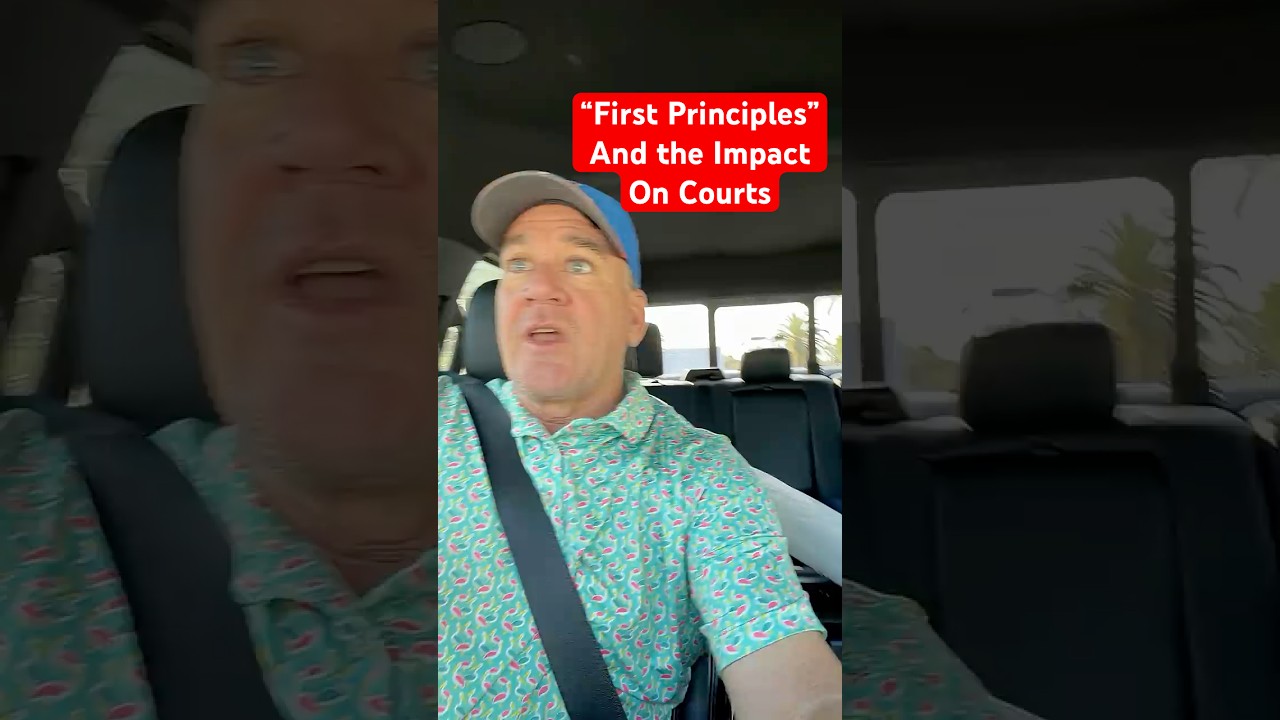

In short: “First principles” means going back to the actual words of the constitution, statute or rule instead of relying on layers of later case law. Since 2020 the Florida Supreme Court has embraced that approach, receded from long-standing precedent, and adopted rules that change how cases end. Litigants who argue only from old cases are at a disadvantage.
What “first principles” means in a courtroom
In engineering and business, first-principles thinking means breaking a problem down to what is actually known and reasoning up from there. In law, the equivalent is starting from the governing text: what does the statute, rule or constitutional provision actually say?
The traditional approach starts somewhere else: what did earlier courts say, and what has always been done? Over decades, those layers can drift from the text they were supposed to interpret.
How the Florida Supreme Court has shifted
The Florida Supreme Court has said repeatedly that the text of a statute controls. In Ham v. Portfolio Recovery Associates, 308 So. 3d 942 (Fla. 2020), it described the supremacy-of-text principle: the words of a governing text are what the court interprets, not legislative purpose or prior gloss.
The court has also been more willing to overrule itself. In State v. Poole, 297 So. 3d 487 (Fla. 2020), it said the question is whether a prior decision is clearly erroneous, and that adherence to precedent alone does not justify keeping a wrong rule.
And it changed procedure. Effective May 1, 2021, Florida adopted the federal summary judgment standard in Rule 1.510, which lets courts end more cases without trial. New case-management rules (Rule 1.200, effective 2025) push cases toward firm deadlines.
The appellate courts are following
District courts are applying the same method. In 2026 the Sixth District held in Ruffenach v. Deutsche Bank that Florida courts do not always need expert testimony to award attorney’s fees, rejecting a requirement it traced to a 1964 decision and certifying conflict with 37 cases from other districts.
The pattern: a long line of cases is tested against the text it rests on, and if the text does not support it, the line can fall.
Supporters and critics
Supporters say text-first judging is more predictable and keeps courts from making policy. Critics say it can unsettle rules that people and businesses have relied on for decades, and that choosing which text controls still involves judgment. Both views are common among Florida lawyers and judges.
What it means if you are in a case
Briefs and motions should start with the governing text and build from there. Citing a string of cases is not enough if the other side can show those cases departed from the statute or rule.
Old “settled” rules are worth re-examining, whether they hurt or help you. In probate, foreclosure and real estate disputes, many procedures rest on case law that has never been tested against current statutory text.
Lessons
- Read the statute or rule first, then the cases.
- Do not assume a decades-old rule will survive a text-based challenge.
- Expect courts to move cases faster under Rules 1.200 and 1.510.
- Preserve text-based arguments in the trial court so they can be raised on appeal.
Source: Florida Rules of Civil Procedure and Florida Statutes on floridarules.net
Watch the Videos
Two short videos on the first-principles approach in Florida courts.
Legal Paradigm Shift: The “First Principles” Approach in Our Courts
“First Principles” and the Forces Reshaping Our Courts
Go Deeper
- Florida’s Summary Judgment Rule: How Rule 1.510 Ends Cases Without a Trial
- Why Florida Judges Are Rushing to Close Cases: Rule 1.200
- How Appeals Work in Florida
Frequently Asked Questions
What does “first principles” mean in law?
Deciding a question from the actual text of the constitution, statute or rule, rather than relying on later case law that may have drifted from that text.
Has the Florida Supreme Court adopted a text-first approach?
Yes. It has stressed the supremacy of statutory text (Ham v. Portfolio Recovery Associates, 2020) and said clearly erroneous precedent can be overruled (State v. Poole, 2020).
Can old Florida case law be overturned?
Yes. Courts have receded from or rejected long-standing rules when they conclude the governing text does not support them.
How should I argue a motion under this approach?
Start with the exact words of the governing statute or rule, explain how they apply, and then use cases to support that reading.
Talk to a Florida litigation lawyer
Weidner Law, P.A. handles civil litigation and appeals in Florida courts from St. Petersburg. If you need a Florida litigation lawyer, call (727) 954-8752 or email weidner@mattweidnerlaw.com.
Read the rules yourself, free: the Florida Rules of Court and Florida Statutes are on floridarules.net.
This article is general information about Florida law, not legal advice about your situation. Reading it, watching the videos, or contacting the firm does not create an attorney-client relationship. Every case turns on its own facts, and past results do not guarantee a similar outcome. The hiring of a lawyer is an important decision that should not be based solely upon advertisements.
