
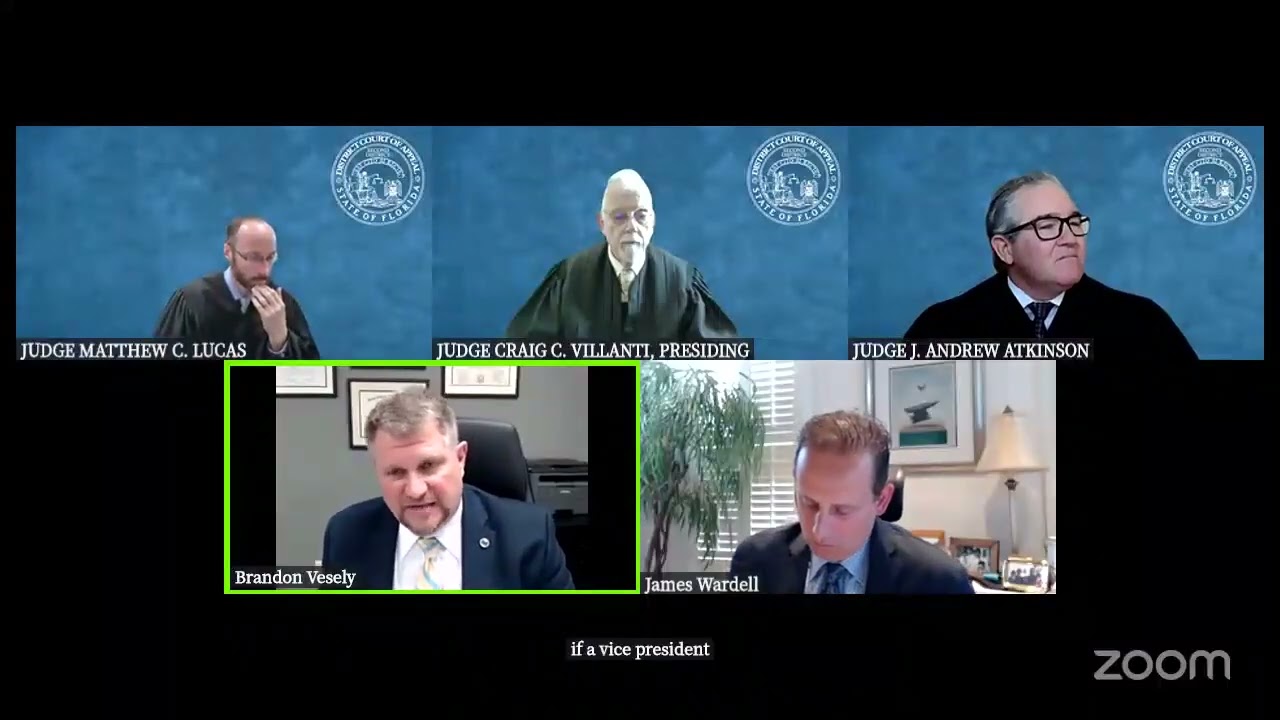
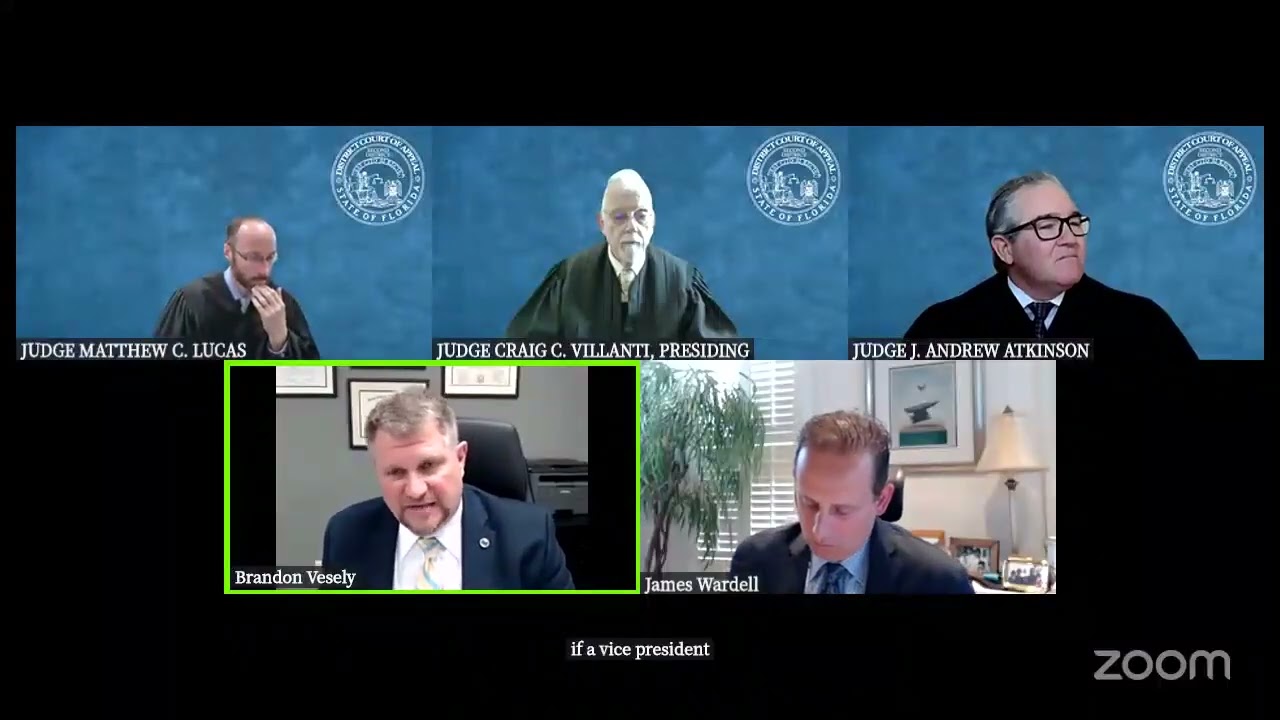
In short: Executive Mortgage & Investments and its president challenged a transfer of property, arguing an officer signed a deed without proper authority. The Hillsborough trial court ruled against them, and on January 3, 2025, the Second DCA affirmed without a written opinion.
The Facts
The Second District affirmed without an opinion, so the facts here come from the arguments as framed in the oral argument videos, not from appellate findings.
Rudolph Wesley, as president of Executive Mortgage & Investments, Inc., and the company appealed a judgment from Hillsborough County circuit court (case 18-CA-002997) in a dispute with Curtis Davis and DeKloet Real Estate Partnership. The videos frame the core issue as whether a vice president could sign a deed in lieu of foreclosure, or otherwise convey company property, without board approval, and whether the transfer was binding.
The arguments also touched on Florida’s limited partnership statutes in chapter 620, which govern when a partner’s signature binds a partnership.
The Decision
On January 3, 2025, a panel of the Second District affirmed in a one-word per curiam decision. The trial court’s judgment stood. With no opinion, the court did not explain whether it found the officer had authority, that the company ratified the act, or that the issue was not preserved.
The Law
Whether a deed signed by one person binds an entity depends on that person’s actual or apparent authority. For limited partnerships, section 620.1402, Florida Statutes makes each general partner an agent of the partnership: an act apparently in the ordinary course binds the partnership unless the general partner lacked authority and the other party knew or had notice of it. Acts outside the ordinary course bind the partnership only if the other partners approved them.
Corporations follow similar agency principles. Officers have the authority given by the bylaws or the board, and a corporation can also be bound by apparent authority or by ratifying a transaction after the fact, for example by accepting its benefits.
Lessons
- Before accepting a deed or deed in lieu from an entity, get a board or partner resolution authorizing the signer.
- Title insurers routinely require proof of authority. Do not skip it in private deals.
- If someone conveys your company’s property without authority, act quickly; delay and accepting benefits can look like ratification.
- An appellate PCA ends most cases. Build your record in the trial court.
Source: Wesley v. Davis, No. 2D2023-2330 — Fla. 2d DCA (January 3, 2025).
Watch the Oral Argument
This is the recording of the actual oral argument, posted on the channel. What lawyers and judges say at argument is not the ruling; the decision is summarized above. (The channel has this argument posted twice; the other upload is here.)
Real Estate Mortgage Dispute | Wesley v. DeKloet Partnership, 2D23-2330
Go Deeper
- Deed in Lieu Held in Escrow: Court Can Order Foreclosure Instead (Safe Harbor v. 9775 Dixie)
- Deed Fraud in Florida: How Homes Are Stolen on Paper and How to Get Them Back
- Who Gets the House? A Disputed Family Deed and the Recording Act (Cutlip v. Dorsey)
Frequently Asked Questions
Can a corporate officer sign a deed without board approval in Florida?
Sometimes. An officer may have actual authority under the bylaws or a resolution, or apparent authority if the company led others to believe the officer could act. A transfer outside that authority can be challenged, but the company may still be bound if it ratified the deal or the buyer reasonably relied on apparent authority.
Who can sign a deed for a Florida limited partnership?
Generally a general partner. Under section 620.1402, a general partner’s act in the ordinary course binds the partnership unless the general partner lacked authority and the other party knew or had notice of it. Acts outside the ordinary course need the approval of the other partners.
What is a deed in lieu of foreclosure?
It is a deed in which the owner transfers mortgaged property to the lender, or someone the lender designates, to avoid a foreclosure lawsuit. Because it gives up the property, the signer must have authority to convey it, and lenders usually require a resolution or consent when the owner is an entity.
Can I challenge a deed signed by someone without authority?
Yes. Florida courts can void or set aside a deed executed without authority, but defenses such as ratification, apparent authority, bona fide purchaser status and limitations periods may apply. These cases depend heavily on the documents and on how quickly the owner objected.
Talk to a Florida title and property dispute lawyer
Weidner Law, P.A. handles quiet title, deed, lien and title disputes from St. Petersburg, backed by more than 25 years of title work. If you need a real estate litigation lawyer, call (727) 954-8752 or email weidner@mattweidnerlaw.com.
Read the law yourself, free: every Florida statute and court rule is on floridarules.net.
This article is general information about Florida law, not legal advice about your situation. Reading it, watching the videos, or contacting the firm does not create an attorney-client relationship. Every case turns on its own facts, and past results do not guarantee a similar outcome. The hiring of a lawyer is an important decision that should not be based solely upon advertisements.
