
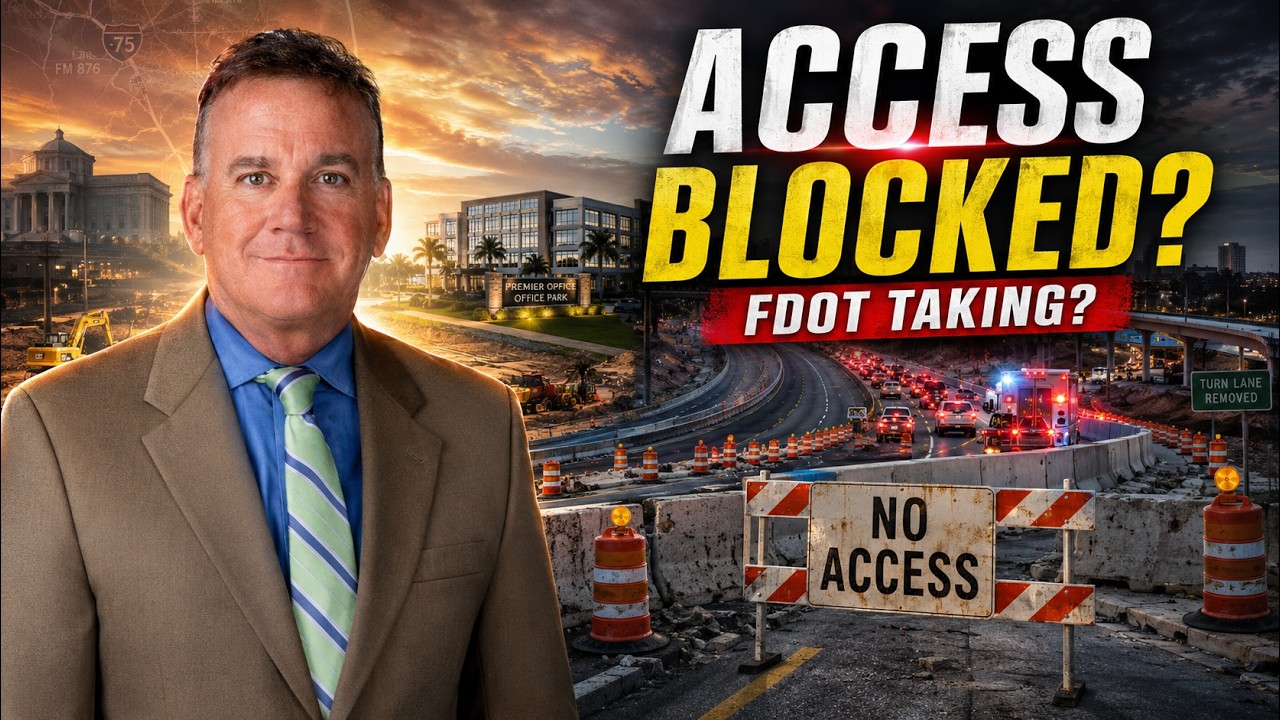
In short: Only if the remaining access is substantially diminished. Florida law protects reasonable access to the public road system, not a particular median opening or turning movement. In Hudson Parkside, LLP v. Department of Transportation, the owner of a Pinellas County office park sued after FDOT’s U.S. 19 reconstruction left it on a one-way frontage road. After a bench trial the court ruled for FDOT, and the Second District affirmed without a written opinion on June 26, 2019.
The Facts
Hudson Parkside, LLP owned a commercial office park whose access road, Ameritech Way, connected to U.S. 19 in Pinellas County. According to its lawyer, the property had both common-law access and an express easement of access to the U.S. 19 right-of-way, and before construction it had full turning movements in and out through a median opening.
Over three overlapping FDOT projects, the median opening was closed, a barrier wall eventually went up, and access was moved to a one-way frontage road. Hudson Parkside sued for inverse condemnation, claiming a taking of its access. After a bench trial, the trial court ruled for FDOT on two grounds: the claim was filed too late, and on the merits the loss of access was not substantial.
There is no written opinion, so the points below are what the lawyers argued at the June 12, 2019 oral argument.
- Hudson Parkside argued the claim did not accrue until the final route was fixed, because medians north of the property kept closing between 2010 and 2012 and the circuity of travel grew over time.
- It said its southbound detour was close to 18,000 feet, far worse than in the Florida Supreme Court’s Tessler case, that it had no secondary access, and that its express easement gave it a right to reach U.S. 19 itself, not just the road network.
- FDOT argued the trial court’s findings were supported by competent substantial evidence, including the owner’s own expert, who testified that the turning movements available at the time of trial were the same as when one of the earlier projects was completed.
- FDOT also relied on earlier Second District decisions involving U.S. 19 frontage roads that found no substantial loss of access, and argued the way the access right arose, by easement or common law, does not change the test.
The Decision
The Second District affirmed per curiam on June 26, 2019, with no written opinion, and issued its mandate July 25, 2019. The judgment for FDOT stands.
Because the trial court ruled on both the statute of limitations and the merits, the affirmance does not tell us which ground the appellate court relied on. A per curiam affirmance decides this case only.
The Law
Article X, section 6 of the Florida Constitution requires full compensation when private property is taken for public use. A property owner’s right of access to the public road system is a property right. In Palm Beach County v. Tessler (Fla. 1989), the Florida Supreme Court held that a taking can occur without a total loss of access, but only when access is substantially diminished. Florida courts have generally held that more roundabout travel or a change in traffic flow, by itself, is not compensable.
The State Highway System Access Management Act puts the same idea in statutory form. Section 335.181(2) says an owner abutting a state highway has a right to reasonable access but not unregulated access, and that FDOT may restrict the operational capabilities of an access connection. Subsection (4) preserves the right to full compensation under the Constitution.
Inverse condemnation claims have a limitations period, and when the claim accrues is often the fight, especially when a road is rebuilt in phases over many years, as it was here.
Lessons
- Losing a median opening or a left turn is usually not enough. An owner has to prove its access as a whole was substantially diminished.
- Document access before, during and after each construction phase. Detour distances and whether there is any secondary access drive these cases.
- Watch the clock. If construction is phased, get advice early about when a claim may accrue rather than waiting for the last phase.
- An express access easement may help, but the owner still has to prove substantial diminution of access.
- A per curiam affirmance after a bench trial usually means the appellate court found the trial judge’s factual findings supported by the evidence.
Source: Hudson Parkside, LLP v. Department of Transportation, No. 2D18-2341 (Fla. 2d DCA June 26, 2019) (per curiam affirmance); ACIS docket.
Watch the Oral Argument
This is the recording of the actual oral argument, posted on the channel. What lawyers and judges say at argument is not the ruling; the decision is summarized above.
🚗 FDOT Reconstructed the Highway & BLOCKED Our Access — Is It a Taking? FL Eminent Domain Appeal
Go Deeper
- Does MRTA Protect FDOT Land Held in Fee for a Drainage Canal? (DOT v. Mid-Peninsula Realty)
- Easement Disputes in Florida: Utility, Access, and Prescriptive Easements
- Can a Court Block a Sidewalk Without Hearing From Those It Hurts? (Two Islands v. Clarke)
Frequently Asked Questions
Can I sue FDOT if a road project blocks access to my business?
You can bring an inverse condemnation claim, but you must prove your access was substantially diminished, not just made less convenient. In Hudson Parkside the owner lost its direct turns onto U.S. 19 and still lost at trial, and the Second District affirmed.
Is closing a median opening a taking in Florida?
Usually not by itself. Florida protects reasonable access to the road system, and section 335.181 lets FDOT restrict the operation of an access connection. Courts look at the remaining access as a whole.
What is inverse condemnation?
It is a lawsuit by a property owner claiming the government took property without paying for it, even though the government never filed an eminent domain case. If a taking is found, the case moves on to compensation.
How long do I have to file an access-taking claim?
There is a limitations period, and in Hudson Parkside the trial court found the claim was filed too late. When the claim accrues can be disputed when a highway is rebuilt in phases, so talk to a lawyer early rather than waiting for the last project to finish.
Talk to a Florida real estate litigation lawyer
Weidner Law, P.A. handles Florida real estate disputes, title problems and appeals from St. Petersburg. If you need a real estate litigation lawyer, call (727) 954-8752 or email weidner@mattweidnerlaw.com.
Read the law yourself, free: every Florida statute and court rule is on floridarules.net.
This article is general information about Florida law, not legal advice about your situation. Reading it, watching the videos, or contacting the firm does not create an attorney-client relationship. Every case turns on its own facts, and past results do not guarantee a similar outcome. The hiring of a lawyer is an important decision that should not be based solely upon advertisements.
