
In short: No, not through the courts by certiorari. In West Villagers for Responsible Government v. City of North Port, the Second District held on November 19, 2025 that a city’s decision whether to shrink its boundaries (contraction, often called de-annexation) is a legislative act, so the circuit court had no certiorari jurisdiction to review North Port’s refusal. The court quashed the circuit court’s order, rehearing was denied, and the residents have asked the Florida Supreme Court to review the case.
The Facts
In 2020, West Villagers for Responsible Government, Inc. and John Meisel petitioned the City of North Port under section 171.051 to contract its boundaries and remove the West Villages area (Wellen Park) from the city. The statute required the city to study feasibility and then either begin the process of enacting a contraction ordinance or reject the petition and state the facts supporting its rejection.
The City Commission held hearings under its quasi-judicial procedures and denied the petition in 2021. The circuit court granted certiorari and quashed that denial, finding the city’s reasons were conclusory and that it had used the wrong meaning of “feasibility.” The Second District denied the city’s petition for second-tier review in 2022 (City of North Port v. West Villagers for Responsible Government, Inc., 348 So. 3d 680 (Fla. 2d DCA 2022)).
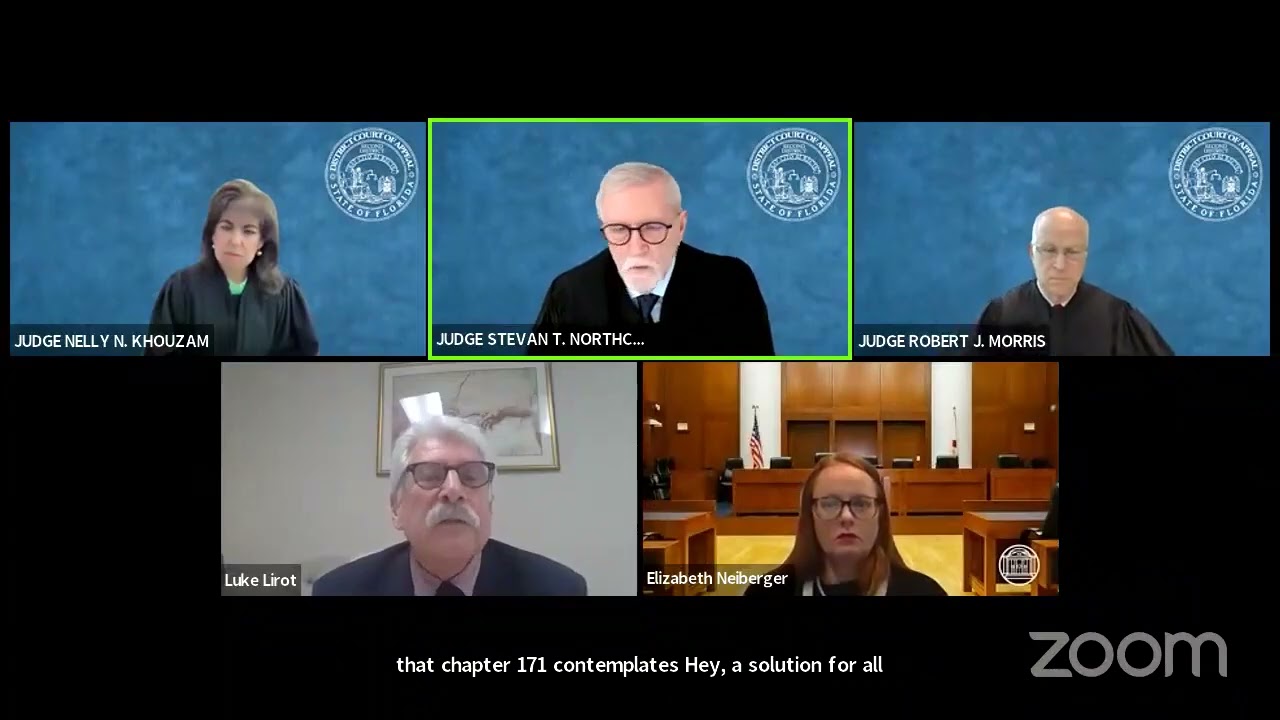
On remand the Commission, using the same record, rejected the petition again with more detailed findings. This time the circuit court denied the residents’ certiorari petition, and they sought second-tier certiorari in the Second District. The case was argued by video on April 23, 2024. At the start, the panel told counsel it was concerned whether courts could review the city’s decision at all and would ask for supplemental briefs. The points below are what the lawyers argued.
- The residents argued that the first circuit court decision was binding (res judicata and law of the case), that the city’s own report conceded the area contained enclaves, which meant it never met the annexation criteria and was eligible for contraction, and that the city denied the petition without competent substantial evidence.
- The city argued that res judicata does not attach to an appellate decision quashing an order and sending the case back, that on remand a body may make the specific findings a reviewing court said were missing, and that the first court’s comments on enclaves were dicta.
- The panel asked both sides whether changing municipal boundaries is a legislative power, noted that the 2023 amendments to chapter 171 defined “feasibility study” without mentioning evidence, and asked whether the city’s choice of quasi-judicial procedures could make the decision quasi-judicial.
The Decision
The Second District first denied the petition without an opinion on May 3, 2024. After the residents moved for a written opinion, the court ordered supplemental briefing, withdrew the unexplained denial on December 18, 2024, and issued a written opinion on November 19, 2025.
The court held that the circuit court had no jurisdiction to review North Port’s refusal. Section 171.081 allows review only of an annexation or contraction ordinance that has been passed, not a decision not to enact one, and it is the exclusive way to challenge a municipality’s compliance with chapter 171. Common-law certiorari was not available either, because establishing and changing municipal boundaries is a legislative power, and certiorari does not reach legislative acts. The city’s decision to use quasi-judicial procedures did not change that; what matters is the kind of hearing the law requires, and section 171.051 required a feasibility study and a decision, not an evidentiary hearing.
The court quashed the circuit court’s order that ruled on the merits. It also said the 2023 amendments, which declare a rejection of a contraction petition to be legislative, clarified rather than changed the law. Rehearing and rehearing en banc were denied on March 26, 2026, and the mandate issued April 13, 2026. On April 24, 2026 the docket shows a notice invoking the Florida Supreme Court’s discretionary jurisdiction (No. SC2026-0632). We did not find a ruling on that request.
The Law
Chapter 171 is Florida’s Municipal Annexation or Contraction Act. Section 171.051 sets the contraction procedure, including the feasibility study and the city’s decision, and section 171.052 lists areas that may be contracted. Definitions, including “feasibility study,” are in section 171.031.
Section 171.081 provides the review mechanism: an affected party may seek review by petition for certiorari after an annexation or contraction ordinance is passed. In West Villagers the court held that this route does not apply when the city declines to pass an ordinance.
Current law (2026): Chapter 2023-305, Laws of Florida, amended section 171.051 for petitions filed on or after July 1, 2023. A city rejecting a contraction petition no longer must state supporting facts, the rejection is declared a legislative decision, and a new consent requirement applies when more than 70 percent of the area is privately owned by entities that are not electors. The definition of “feasibility study” in section 171.031 was added by the same law.
Lessons
- A petition to de-annex is a request to a legislative body. If the city says no, the courts generally cannot make it say yes.
- Residents who want out of a city should focus on the political process: the commission, the referendum provisions and, where possible, the Legislature.
- A city’s choice to hold a quasi-judicial style hearing does not create court review that the law does not provide.
- Raise jurisdiction early. Here a case that had already been through circuit court twice and one DCA review ended on a jurisdictional point the parties had not briefed until the panel asked.
Source: West Villagers for Responsible Government, Inc. v. City of North Port, No. 2D2023-2425 (Fla. 2d DCA Nov. 19, 2025); Fla. 2d DCA docket (rehearing denied March 26, 2026; Supreme Court review sought, No. SC2026-0632). Earlier decision: City of North Port v. West Villagers for Responsible Government, Inc., 348 So. 3d 680 (Fla. 2d DCA 2022).
Watch the Oral Argument
This is the recording of the Second District oral argument on April 23, 2024, posted on the channel. What lawyers and judges say at argument is not the ruling. The written opinion came out in November 2025.
🏗️ Can Residents Force a City to De-Annex Their Land? | West Villagers v. Northport
Go Deeper
- Code Enforcement Appeals Get Full Appellate Review (MGM of West Florida v. Manatee County)
- Daytona Beach Vacation Rental Owners Lose on Appeal (Synk v. City of Daytona Beach)
- A 1974 Park Deed's Reverter Clause Survives: Not a Dedication Under 95.36 (1000 Brickell v. City of Miami)
Frequently Asked Questions
Can my neighborhood leave a Florida city (de-annex)?
Residents can petition a city to contract its boundaries under section 171.051, but the decision belongs to the city as a legislative matter. In West Villagers v. North Port, the Second District held that courts cannot review a city’s refusal by certiorari.
Can I appeal a city's refusal to de-annex my property?
Not by certiorari, according to West Villagers. Section 171.081 allows court review only after an annexation or contraction ordinance is passed, and common-law certiorari does not reach legislative acts like setting city boundaries.
Is annexation a legislative or quasi-judicial decision in Florida?
Legislative. Florida courts treat establishing and changing municipal boundaries as a legislative power, and the Second District held that this is true even when a city chooses to use quasi-judicial hearing procedures.
What changed in Florida's contraction law in 2023?
For petitions filed on or after July 1, 2023, section 171.051 declares a city’s rejection of a contraction petition a legislative decision, drops the requirement to state supporting facts, and adds a consent requirement in some areas owned mostly by non-elector entities. The 2023 law also defined “feasibility study” in section 171.031.
Talk to a Florida real estate litigation lawyer
Weidner Law, P.A. handles Florida real estate disputes, title problems and appeals from St. Petersburg. If you need a real estate litigation lawyer, call (727) 954-8752 or email weidner@mattweidnerlaw.com.
Read the law yourself, free: every Florida statute and court rule is on floridarules.net.
This article is general information about Florida law, not legal advice about your situation. Reading it, watching the videos, or contacting the firm does not create an attorney-client relationship. Every case turns on its own facts, and past results do not guarantee a similar outcome. The hiring of a lawyer is an important decision that should not be based solely upon advertisements.
