
In short: Not automatically: in Florida, a buyer who wires money to a fraudster has to prove the closing agent breached a duty it actually owed and that the breach caused the loss, and an escrow agent’s core duties usually begin when it receives the funds. In Burns v. Koontz & Associates, buyers wired $358,342.36 in closing funds to an impostor after emails spoofing the closing agent’s office, then sued the agent, arguing it wrongly refused to let them pay by check. The trial court entered summary judgment for the closing agent, and the Second District affirmed without a written opinion on December 20, 2024.
The Facts
In April 2021 Joseph R. D. Burns and Marcia Colter-Burns contracted to buy a home in the Bradenton area. The contract named Koontz & Associates, PL as escrow and closing agent, and Linda Romanowski of the firm handled the file. She asked the buyers to wire their earnest money deposit using the firm’s wiring form, and they did. According to the buyers, Mr. Burns later asked to hand-deliver a bank check for the balance and was told the funds had to be wired.
On May 11, 2021, about a week before the May 19 closing, Mr. Burns received emails that appeared to come from Ms. Romanowski asking for $358,342.36 to be wired to an account at a different bank, on a form that looked like the firm’s. He wired the money, was told by a further spoofed email that there was a problem, and wired it again. On May 17 he called the firm about the closing time and learned it had not received the funds. The email had been spoofed, and the money went to an impostor.
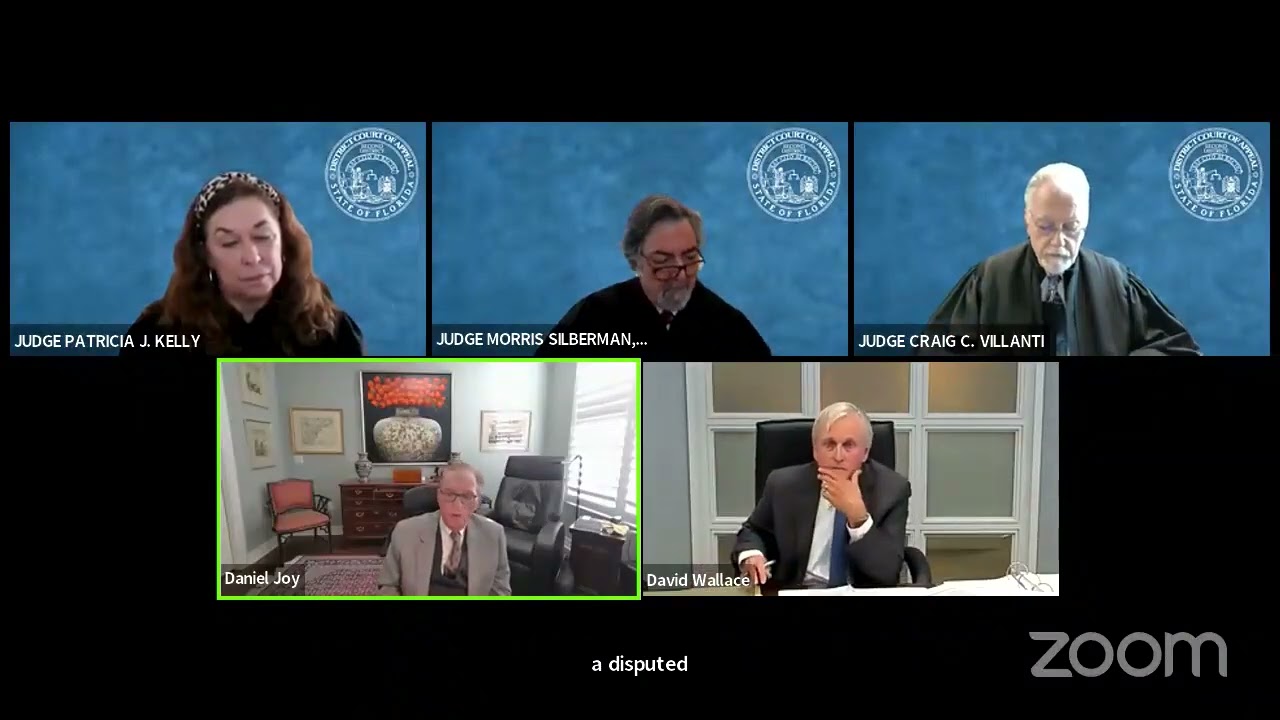
The buyers sued the firm, Jo Ann Koontz and Ms. Romanowski in Sarasota County circuit court. The trial court denied the buyers’ motion for partial summary judgment on breach and granted the closing agent’s motion for summary judgment. The buyers appealed (No. 2D2024-0192), and the case was argued by video on December 4, 2024. Daniel F. Joy III argued for the buyers and David A. Wallace for the closing agent. The points below are what the lawyers argued, not findings by the appeals court.
- The buyers argued that an escrow agent is governed by the law of agency and must follow its principals’ instructions, and that the purchase contract, which called for closing funds by wire transfer or other collected funds and defined collected funds to include checks, gave the buyers the choice to pay by check.
- They argued the agent breached that duty by insisting on a wire, without explaining the contract, while knowing the risks of wiring, and that the record held enough disputed facts for a jury. They also argued the trial court should have considered their cybersecurity expert’s report.
- The closing agent argued it was not a party to the contract, that the escrow paragraph required it only to deposit, hold and disburse funds it accepted, and that nothing required it to accept a check. No check was ever tendered, and the stolen funds never reached it.
- It argued the buyers ignored a signed wire fraud warning that told them not to accept changed wiring instructions and to call to confirm, even though the second request named a different bank and a new account name. A phone call would have stopped the fraud.
- It argued the buyers’ expert report was unsworn and not proper summary judgment evidence, that the buyers did not challenge that ruling in their initial brief, and that the only proper expert evidence showed the firm’s own systems were not compromised.
The Decision
The Second District affirmed on December 20, 2024. The ACIS docket lists the disposition as “Affirmed,” and no written opinion explaining the reasons was available. The buyers moved for rehearing, rehearing en banc and a written opinion; the court entered an order on those motions on February 25, 2025, and the mandate issued April 7, 2025.
The same day it affirmed, the court denied the buyers’ motion for appellate attorney’s fees and provisionally granted the closing agent’s motion for appellate fees under the offer of judgment statute, section 768.79, and rule 1.442, leaving entitlement and amount to the trial court.
Because there is no opinion, the affirmance does not say whether the court accepted the no-duty argument, the causation argument or something else. It means the summary judgment for the closing agent stands. It is not a published rule that closing agents can never be liable for wire fraud.
The Law
Florida courts generally treat an escrow agent as owing duties defined by the escrow terms: to hold and disburse the money it receives according to the parties’ instructions. Courts have been reluctant to expand those duties beyond what the parties agreed. The buyers argued agency law required the agent to follow every instruction in the purchase contract, including the payment terms; the agent argued its duties under the contract’s escrow paragraph began only when it accepted funds.
The case was decided under the current summary judgment rule, rule 1.510, which since May 1, 2021 follows the federal standard. A party opposing summary judgment must point to evidence in the record that would let a reasonable jury find in its favor. Whether an unsworn expert report counts was one of the disputes here.
Winning a negligence or breach claim also requires proof of causation. The closing agent argued the buyers’ own failure to verify the changed wiring instructions, as their signed wire fraud advisory directed, was the cause of the loss.
Lessons
- Never wire closing funds on emailed instructions alone. Call the closing agent at a number you already know, not one in the email, and confirm every detail before sending.
- Treat any change in bank, account name or account number as a red flag. Stop and verify before sending a second wire.
- Read the wire fraud advisory you sign. Courts and opposing lawyers will point to it if you did not follow it.
- If your contract lets you pay by cashier’s check or other collected funds and you want to, put the request in writing and tender the check.
- An offer of judgment can shift attorney’s fees to the losing side, including on appeal.
Source: Burns v. Koontz & Associates, PL, No. 2D2024-0192 — Fla. 2d DCA docket (affirmed December 20, 2024).
Watch the Oral Argument
This is the recording of the actual oral argument, posted on the channel. What lawyers and judges say at argument is not the ruling; the decision is summarized above.
📑 Closing Agent Liable for Wire Fraud Loss — Escrow Duties in Real Estate? | 24-0192 | FL DCA
Read the Law on FloridaRules.net
The statutes and court rules discussed in this article, free to read on FloridaRules.net:
Go Deeper
- The Closing Agent Stole the Money: Who Takes the Loss, Buyer or Seller? (Kleyman v. Etheria)
- Lender's Wired Money Vanished: Did the Escrow Lawyer Owe Him a Duty? (Brock v. Miklas)
- Florida Real Estate Fraud Is REAL — and It's on the Rise in 2026
Frequently Asked Questions
Is the title company liable if I wire money to a scammer?
Not automatically. You have to prove the title or closing company breached a duty it owed you and that the breach caused your loss. In Burns v. Koontz, the closing agent won summary judgment after arguing its escrow duties began only when it received funds and that the buyers ignored a wire fraud warning, and the Second District affirmed.
How do I avoid wire fraud when buying a house in Florida?
Call the closing agent at a phone number you got independently, before every wire, and confirm the bank, account name and account number. Be suspicious of any email that changes wiring instructions. In Burns, the second wire request named a different bank and a new account name.
Can a closing agent refuse to accept a cashier's check?
It depends on the contract and escrow terms. The buyers in Burns argued their contract allowed payment by check; the closing agent argued nothing required it to accept one and that no check was ever tendered. The affirmance came without an opinion, so it does not answer the question generally.
Who pays the lawyers if I lose a wire fraud lawsuit?
Usually each side pays its own, but an offer of judgment under section 768.79 and rule 1.442 can shift fees to a party that rejects a reasonable offer and then loses. In Burns, the court provisionally granted the closing agent’s appellate fee motion under that statute.
Talk to a Florida real estate litigation lawyer
Weidner Law, P.A. handles Florida real estate disputes, title problems and appeals from St. Petersburg. If you need a real estate litigation lawyer, call (727) 954-8752 or email weidner@mattweidnerlaw.com.
Read the law yourself, free: every Florida statute and court rule is on floridarules.net.
This article is general information about Florida law, not legal advice about your situation. Reading it, watching the videos, or contacting the firm does not create an attorney-client relationship. Every case turns on its own facts, and past results do not guarantee a similar outcome. The hiring of a lawyer is an important decision that should not be based solely upon advertisements.
