
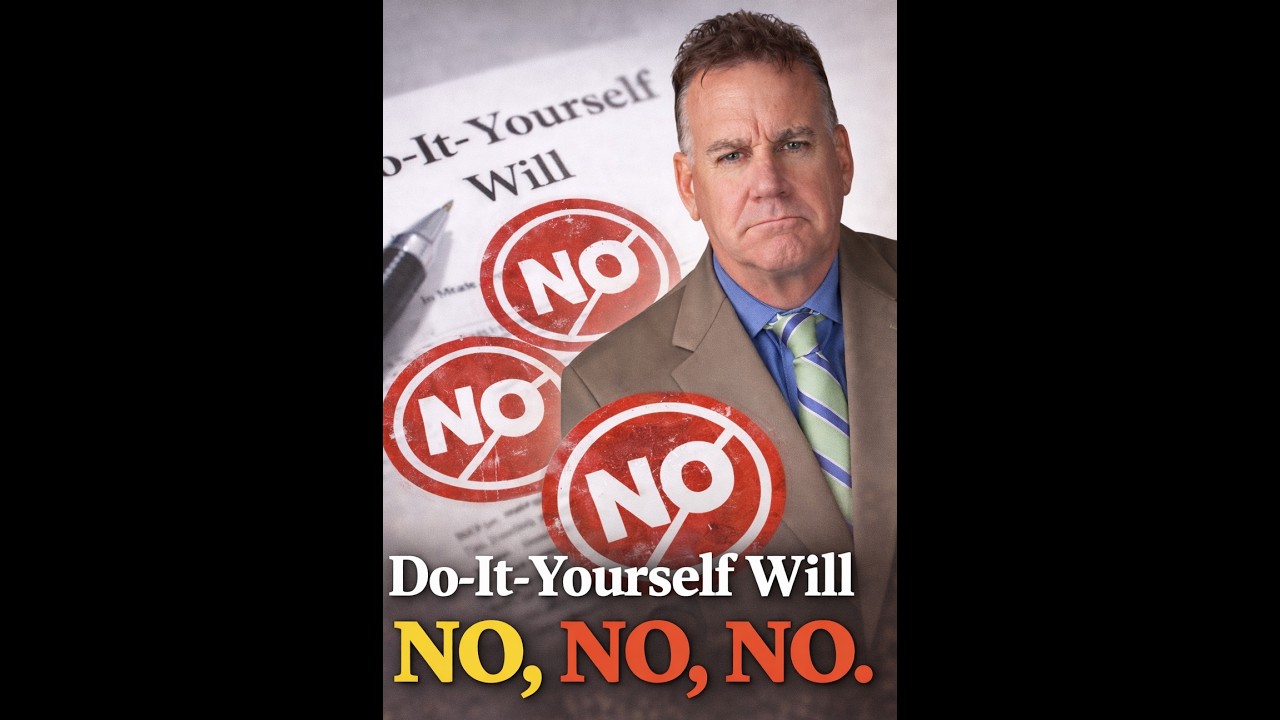
A man was dying. A well-meaning friend helped him prepare his will — the document that would control the distribution of a $3 million estate. That friend had no legal training. They were trying to help. And what they produced handed me exactly what I needed to invalidate the entire document under Florida law.
A Real Case. A $3 Million Estate. A Fatal Flaw.
This is a real case study. Real facts. Real family. Real $3 million at stake. What I found buried in Florida case law — not the statute itself — was the entire case. And I am confident that most experienced attorneys, not just general practitioners, would have missed it.
The scenario plays out more often than most families realize. Someone is sick. Time is short. A family member, a friend, a neighbor helps fill out a form or pulls a template off the internet. The document gets signed. Everyone believes the estate is handled. Nobody finds out how wrong that assumption was until the family is already in probate court.
Why DIY Wills Fail Under Florida Law
Online will platforms, legal form sites, and do-it-yourself estate planning documents are not reviewed by Florida attorneys. They are not tailored to Florida’s specific execution requirements, witness requirements, or the body of Florida case law interpreting what makes a will valid or invalid. They look like wills. They are signed like wills. And in cases like this one — they get thrown out like they were never written.
The most dangerous part of a defective will is that nobody knows it is defective until after the person who signed it is gone. At that point the document cannot be fixed. The person who wrote it cannot explain what they meant. And the family that believed the estate was settled walks into a courtroom.
Florida Will Execution Requirements — § 732.502
Under Florida Statute § 732.502, a valid will must be in writing, signed by the testator (or another person in the testator’s presence and at their direction), and signed by two witnesses in the testator’s presence. Florida’s courts have developed a substantial body of case law around what satisfies — and what fails — these requirements.
A document that looks exactly like a will and is signed in good faith can still be thrown out if it fails to meet Florida’s technical execution standards or runs afoul of controlling case law. This is not a technicality — it is the law.
What This Means for Your Family
If your family is currently in probate court over a disputed will — especially one that was prepared without an attorney — you need a Florida probate litigator who knows both the statutes and the case law. The argument that wins these cases is rarely on the face of the statute. It is buried in decades of Florida appellate decisions.
Contact Weidner Law today for a consultation if you are facing a will contest in Florida.
Read the Exact Statute
The Florida statutes and probate rules cited in this article are published word-for-word — free, complete, and fully organized — at FloridaRules.net.
- § 732.502 — Execution of Wills | FloridaRules.net
- Chapter 733 — Probate Code: Administration of Estates | FloridaRules.net
- Florida Probate Rules | FloridaRules.net
FloridaRules.net — Every Florida Probate Rule, Statute, and Case Commentary. In One Place.
