
Florida voters just cut their own property taxes. Now cities and counties have to decide what to cut, what to replace, and who pays for it. I talked through exactly that on WUSF’s Florida Matters Live & Local, and you can watch the full episode right below. This post is the short version.
WATCH THE FULL EPISODE
Florida Matters Live & Local on WUSF, November 9, 2026. I join the panel on what Amendment 3 means for local funding.
The panel included host Matthew Peddie, Matthew Weidner, Lindsay Cross of the Trust for Public Land, former state senator Jeff Brandes of the Florida Policy Project, and Manatee County Commission Chair Tal Siddique.
What happened
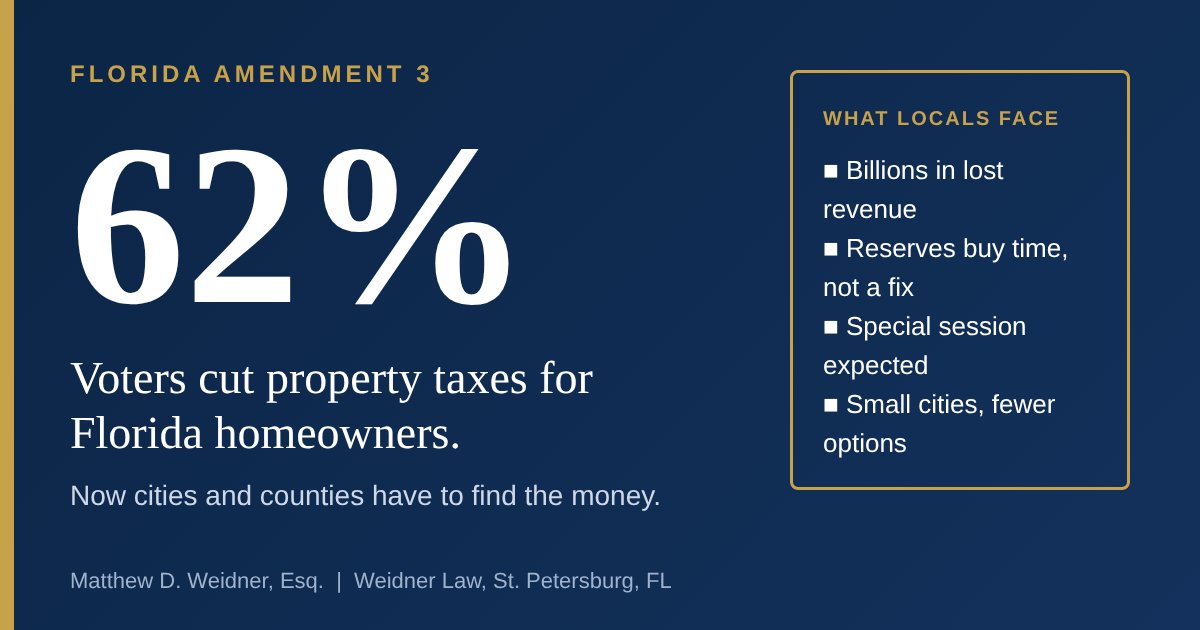
According to WUSF, Amendment 3 is a property tax cut for Florida homeowners, and voters approved it with 62 percent of the vote. A margin like that settles whether voters wanted this. What remains is the harder question of how it works in practice.
The money has to come from somewhere
Property taxes are the main way Florida’s cities and counties pay for local services. WUSF reports that the amendment puts billions of dollars in local revenue at stake. That is the budget that pays for the things residents call their local government about: public safety, roads, parks, water, and code enforcement.
The episode also raised concern for conservation lands, water management, and smaller communities. Brandes expects loud objections from smaller cities with fewer options. Cross called the measure a “big hairy mess” that was not fully thought through before it went to voters.
Reserves are a bridge, not a fix
My point in the discussion was simple. Some local governments may be able to lean on their reserves in the short term. That buys time, but it does not solve the longer-term problem. A reserve you spend once is gone, and the lost revenue does not come back on its own.
I also said local governments cannot afford to wait to assess the financial consequences. The cities and counties that start modeling the impact now will make better decisions than the ones that wait for a crisis in the middle of a budget cycle.
What comes next
WUSF reports that Governor DeSantis is preparing to call lawmakers into a special session to implement the amendment. That session is where many of the real answers will be decided: how the cut is carried out and what, if anything, is done to help local governments absorb it. I will not guess at the outcome. Watch what the Legislature actually passes, not what is said about it beforehand.
What this means for property owners and residents
If you own a home in Florida, the tax cut is real, and so are the tradeoffs. Three things are worth watching over the coming months:
- Your local budget process. Attend or watch the meetings where your city or county discusses how the lost revenue will be made up. That is where decisions about service levels, fees, and other revenue sources get made.
- Fees and assessments. When property tax revenue shrinks, governments may look at other ways to raise money. Read your notices carefully, because a fee or special assessment is not a property tax, but it still comes out of your pocket.
- Collection of what is already owed. Tighter budgets can put more focus on unpaid liens, code fines, and assessments. If you owe one, do not assume it will be quietly forgotten.
Bottom line
Amendment 3 passed by a wide margin, and the local funding questions it raises are still open. The details will be worked out in a special session and then in every city and county budget room. If you have questions about how these changes affect your property, your business, or a municipal lien or assessment, call our office at 727-542-5571.
This post is general information, not legal advice for your situation. Reported details about Amendment 3 come from WUSF’s description of the episode, and the final law and its implementation may differ from what has been discussed so far.
Matthew D. Weidner, Esq.
Weidner Law, P.A.
856 2nd Avenue North, St. Petersburg, FL 33701
